Circular Capital: AI's Closed Loop Drowns Real Returns
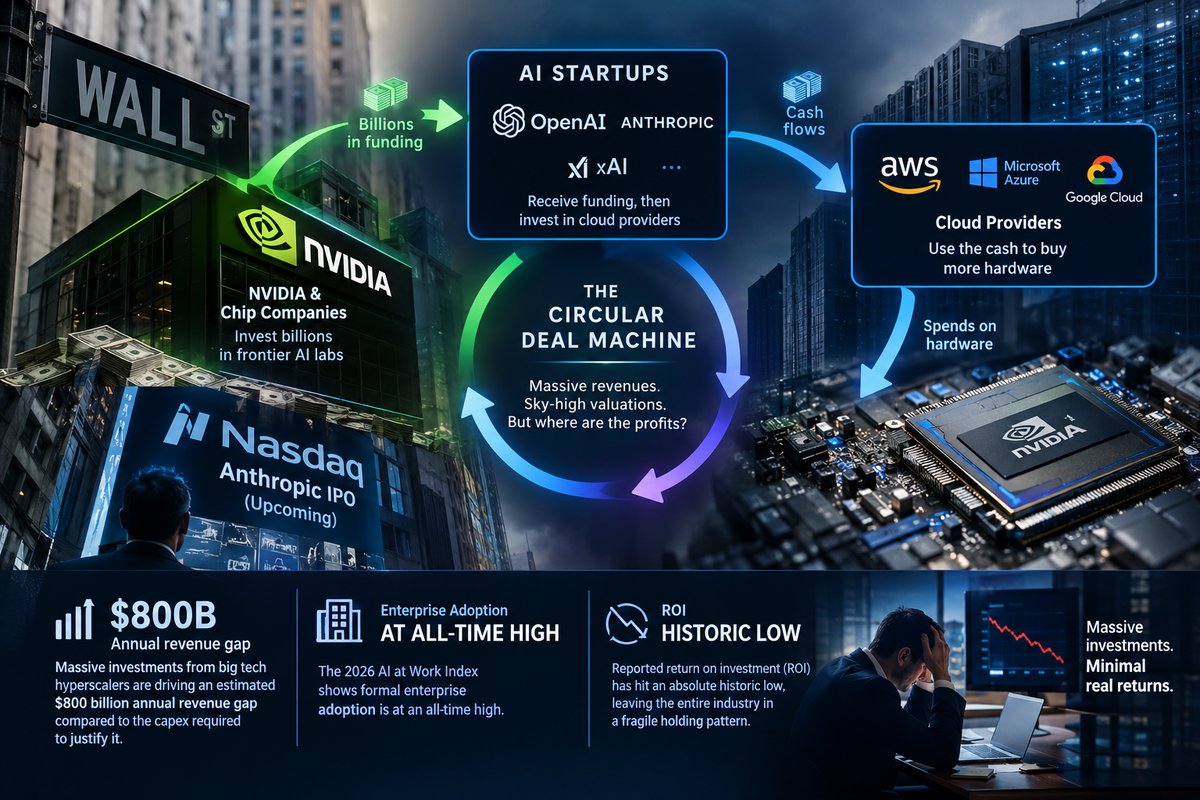
The closed-loop capital circuit: chipmaker → frontier lab → hyperscaler cloud → chipmaker. External enterprise demand sits outside the loop, underlit and unreached.
A structural feedback loop between chipmakers, frontier AI labs, and hyperscaler cloud divisions has manufactured an illusion of revenue while enterprise ROI collapses to historic lows. The $800 billion capex-to-revenue chasm exposed by the 2026 AI at Work Index signals that the sector's growth story is sustained entirely by inter-corporate recycling, not end-user economics.
Location Dateline
SAN FRANCISCO, CALIFORNIA
Circular Capital: AI’s Closed Loop Drowns Real Returns
The Recirculation Engine
The artificial intelligence ecosystem has developed a structural pathology that conventional financial analysis is only now beginning to isolate. A closed-loop capital circuit now dominates the sector: semiconductor leaders—NVIDIA foremost among them—inject multi-billion-dollar grants, equity stakes, and preferential allocation into frontier AI laboratories. Those laboratories, in turn, funnel the liquidity into hyperscale cloud infrastructure contracts. The cloud providers redeploy that same capital expenditure back onto the very same chips. The money moves; no new economic value is created for an external buyer. Revenue lines inflate three times over before a dollar touches an enterprise customer’s balance sheet.
This is not organic demand. It is a closed thermodynamic system where thermal energy recirculates through a loop and the enthalpy change reads as zero net output. Wall Street’s headline revenue multiples and staggering private-market valuations are artifacts of double- and triple-counting within a single consolidated financial perimeter. The upcoming Nasdaq listing of Anthropic, one of the most heavily capitalized frontier labs, arrives into a market that must now price the entity independently of the very subsidy loop that sustains its burn rate.
The $800 Billion Chasm
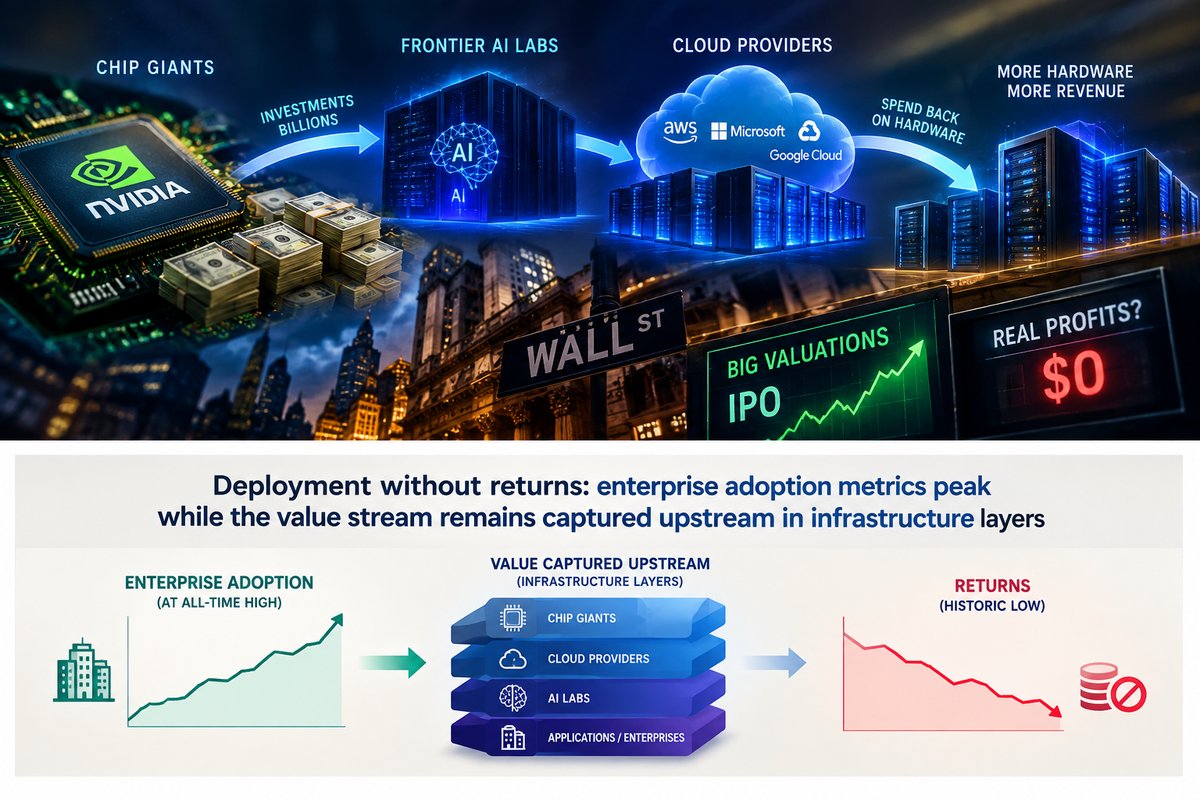
The gap between projected AI-driven revenue and the capital expenditure required to generate it has widened to an estimated $800 billion annually across the hyperscaler cohort. Big tech’s infrastructure spend—racks, power, cooling, interconnect fabric—outstrips the incremental enterprise revenue that AI workloads actually produce for external customers. The capex curve is a straight line climbing at a CAGR that no known application-economics model can justify without circular financing as the bridge.
| Metric | Direction | Context |
|---|---|---|
| Hyperscaler AI capex | Rising sharply | Driven by chip + datacenter build-out |
| Enterprise AI revenue (external) | Flat to marginal | End-user adoption not monetizing |
| Inter-corporate AI revenue share | Dominant | Lab-cloud-chip loop |
| 2026 AI at Work Index: Adoption | All-time high | Formal deployment metrics |
| 2026 AI at Work Index: ROI | Historic low | Reported return on investment |
The 2026 AI at Work Index crystallizes the contradiction: formal enterprise adoption of AI tooling has reached an all-time high, yet reported return on investment has bottomed at a level not seen in any comparable technology transition. Companies are deploying models, integrating APIs, and counting seats. They are not reporting profit. The adoption metric and the ROI metric are decoupled in a way that suggests deployment is being driven by capital allocation mandates and competitive paranoia rather than unit economics.

The Fragility of the Holding Pattern
The architecture holds only so long as every node in the loop continues to treat the next node’s spend as revenue rather than as a pass-through. NVIDIA’s guidance, a hyperscaler’s cloud-services segment, and a frontier lab’s run-rate are not independent economic events; they are the same dollar seen from three ledgers. A shock to any single node—a capex pause at a hyperscaler, a chip-allocation shift, a regulatory intervention on energy subsidies—propagates through the loop within a single quarter and surfaces as a simultaneous revenue correction across three sectors that analysts currently track in isolation.
The Anthropic IPO will force a public-market pricing mechanism onto a private, subsidized entity. If the underwriters and institutional allocators demand a return that is not backed by external, non-circular revenue, the valuation will either compress violently or the subsidy loop must expand to a fifth or sixth node, widening the perimeter and deepening the opacity. Either outcome is a stress test the broader equity market is not currently pricing.
What the Ground Reality Shows
Strip the inter-corporate transfers and the enterprise picture is austere. The sector that is supposed to be the primary beneficiary—mid-cap manufacturers, financial services, logistics, healthcare operations—reports virtually zero incremental profit attributable to AI deployment. The capital is being consumed by the infrastructure layer. The value, to the extent it materializes, accrues to the chip and cloud tiers, not to the application tier. The end user who licenses a model through a hyperscaler API is paying a toll for a transit system whose primary revenue is still the fee from building the transit system itself.
This is not a market. It is a construction phase masquerading as revenue. The variance loop will not close until external demand outpaces internal recirculation, and every current index suggests that crossover, if it arrives, is years out—and contingent on a technology capability that has not yet demonstrated a use case with a positive marginal return outside the subsidy perimeter.
Sources & Methodology
Proprietary Synthesis