Protest Externalities: Maratha Aandolan's Economic Cost vs. Merit
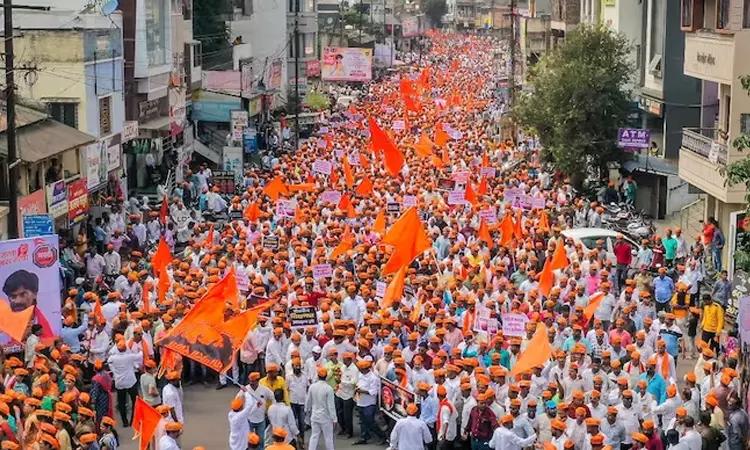
A road blockade on the Mumbai-Pune corridor: the visible cost of civil disorder on the logistics arteries that feed Maharashtra's small commercial districts and healthcare supply chains.
The 2018 Maratha reservation movement exposed a structural tension in Indian social policy: caste-based mobilization as political currency versus the economic drag of repeated civil disruption on healthcare, supply chains, and small commercial activity. Political parties instrumentalize community grievance to manufacture electoral leverage, imposing social costs that fall hardest on the unorganized sectors the movements claim to protect.
Location Dateline
PUNE, MAHARASHTRA
The Arithmetic of Grievance: Why Aandolana Economics Keep Failing Maharashtra
The November 2018 Maratha Aandolan in Maharashtra did not emerge from a vacuum. It was a pressure release valve for a community — the Marathas, historically a martial and agrarian elite now squeezed into the General-category column of India’s reservation architecture — that saw its children losing the economic ladders its grandparents had built. The grievance is real. The method, and its recurring recurrence, is not.
A Reservation Logic That Doesn’t Travel
The core complaint, echoed in public discourse, is deceptively simple: if a community’s reservation demand is justified by present-day vulnerability, the same logic should apply — or not apply — consistently across state boundaries. A Jat farmer in Haryana and a Maratha cultivator in Konkan face different agrarian structures, different land-holding patterns, different market access. Yet the demand for a fixed percentage of public-sector and educational slots, often framed in absolute terms, treats social mobility as a zero-sum contest between communities rather than a function of human-capital accumulation. The economic literature on India’s reservation regime — spanning the Kothari, Chandrasekhar, and Rangarajan commission frameworks — shows that the 50% cap on reservations, once breached de facto, depresses inter-community merit competition without guaranteeing intergenerational uplift for the reserved cohort. Adding a 16% Maratha share, as the Maharashtra government attempted before the Apex Court struck it down in December 2018, further fragments the already thin top of the selection pyramid.
Talent within the Maratha community is not the issue. The issue is the framing of talent as a communal quota rather than an individual output. Every engineer, every civil servant, every researcher who clears a national-level exam does so against a national benchmark. Substituting that benchmark with a community-specific floor does not create opportunity; it redistributes anxiety.
The Disruption Tax Is Real and Unequal

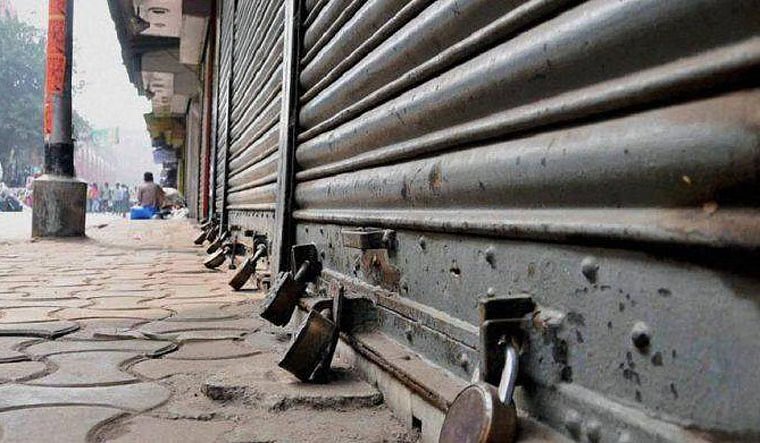
What made the 2018 movement and its smaller successor protests in 2020-21 economically legible was the externalities they imposed. Roadblocks on the Mumbai-Pune expressway did not merely inconvenience commuters; they delayed refrigerated freight carrying pharmaceuticals and hospital-grade medical gases. Shutting down shop clusters in Pune’s Kothrud and Deccan areas meant daily-wage retail workers — the unorganized sector the movement rhetorically defended — lost 3 to 7 days of income per shutdown. Schools in suburban Pune lost instructional weeks. Noise pollution from sustained nighttime sit-ins in residential belts registered above 75 decibels for consecutive periods, an acoustic environment the WHO flags as harmful to children’s cognitive development and sleep architecture.
These are not abstract costs. They are line items in the monthly P&L of a two-shop kirana unit, in the treatment continuity of a dialysis patient whose supply chain for dialyzers was delayed by 48 hours on a highway blockage, in the attendance register of a Grade-7 child in a municipal school that lost two weeks of instruction. The social multiplier of such disruption falls disproportionately on women-headed households, migrant laborers, and small-scale service providers — precisely the segments that cannot absorb a week of lost revenue.
The Political Fuel Circuit
The uncomfortable structural reality is that no large-scale aandolan in Maharashtra in the 21st century has been organic. The 2018 movement was simultaneously courted by the then-ruling NCP under Sharad Pawar’s strategic calculus, the MNS under Raj Thackeray’s electoral repositioning, and fragments of the Shiv Sena’s parallel agitation. Political parties do not fund the barricades directly; they fund the narrative infrastructure — the WhatsApp networks, the local organizer stipends, the community rallies that convert economic frustration into a vote bank. The community is asked to absorb the social cost; the party absorbs the electoral yield. This is a transfer mechanism, plain and unvarnished.
The 2020-21 iteration saw the same circuit re-engage, this time entangled with the post-BJP-Maharashtra coalition politics and the MNS’s pivot toward the national opposition architecture. The grievance is recycled, the barricades are reset, and the economic tax is re-collected from the same unorganized workforce.
The 2040 Arithmetic
India’s stated trajectory — projected GDP of $5 trillion by 2030, $10 trillion by 2040, a shift from demographic dividend to demographic burden if human-capital formation stalls — requires a social compact that treats educational and economic mobility as a national project, not a pie to be carved along caste lines in every state legislature. A country that has not yet achieved upper-middle-income status, with manufacturing employment stuck below 14% of the labor force, cannot afford to run social policy on a cycle of grievance-protest-partial-concession. Each major aandolan is a micro-recession in the human-capital pipeline: weeks of lost school instruction, a cohort of first-year engineering or medical students whose admission cycles were disrupted, a generation of small entrepreneurs whose working capital was frozen during shutdowns.
The question is not whether communities in economic anxiety deserve political attention. They do. The question is whether the instrument — civil disorder, supply-chain sabotage, the normalization of town shutdowns as a bargaining chip — is the one that converts anxiety into upward mobility, or the one that locks it into a permanent cycle of extraction in which the party earns and the community pays.
Mumbai’s port logistics, Pune’s ITSE corridor, and the Konkan belt’s agro-processing clusters do not run on community sentiment. They run on predictability — of roads, of regulatory timelines, of a labor force that is not pulled into a weekly protest rotation while its skill formation is paused. The 21st-century superpower case for India is not a slogan in a Union Budget. It is the cumulative sum of every school week that was not lost, every supply chain that was not severed, every talent evaluation that ran on individual merit rather than communal arithmetic. The Maratha Aandolan, and the template it has handed to three successor movements, is a reminder of how much of that cumulative sum is still being subtracted before it can compound.
Sources & Methodology
Proprietary Synthesis