Pune's Decibel Democracy: Sacred Politics Drowns 21st-Century Living Standards
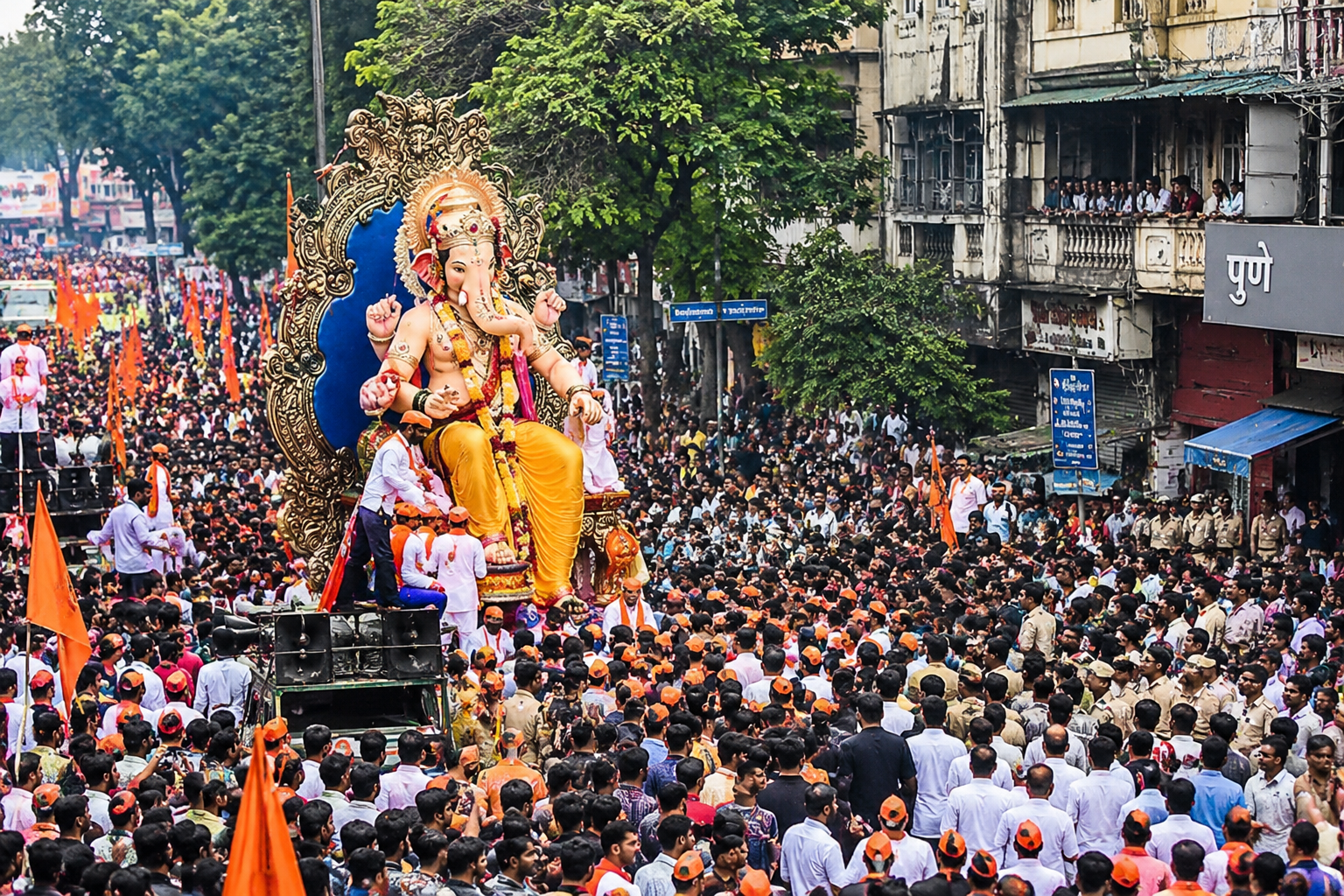
Lord Ganesh festival celebrations in Maharashtra
Annual Ganesh Utsav noise violations in Pune expose a structural governance failure: every tier of political and media actor is contractually incentivized to silence a constitutional right to undisturbed peaceful living under Article 21. The international comparison is not about diminishing religious expression; it is about enforcing the same expression within enforceable acoustic thresholds, as the EU, US, Singapore, and Japan already do.
Location Dateline
PUNE, MAHARASHTRA
Pune’s Decibel Democracy: Governance, Law, and the Sacred Shield
1 · The Factual Core
Each August–September, Pune’s Ganesh Utsav — spanning typically 3 to 10 days across hundreds of mandals and public streets — produces sustained noise loads well above the ambient limits prescribed under the Noise Pollution (Regulation and Control) Act, 1986 and the Indian Standard IS 3847. The Maharashtra State Pollution Control Board (SPCB) sets residential ambient noise at 55 dB(A) daytime / 45 dB(A) night. Continuous dhol, firecrackers, amplified loudspeaker cycles, and ganesh mandal processings routinely breach these limits by 20–40 dB in the immediate acoustic zone. The user’s grievance is not speculative; it is a measurable, repeatable, annual infrastructure failure.
2 · Why the Political Class Stays Silent
This is not incompetence. It is a rational incentive structure.
- Municipal tier (PMC ward offices): Ward councillors derive their electoral viability from mandal networks. The Ganesh mandal is simultaneously a cultural association, a mutual-aid fund, and a micro-political constituency. Issuing a noise notice or enforcing a decibel cap against a 5,000-member mandal is functionally equivalent to declaring war on a voting bloc. The transaction cost of enforcement exceeds the political cost of inaction.
- State tier (Mumbai, MNS, SP, NCP-S, Congress, BJP): In Maharashtra, Ganesh Utsav is a seven-to-ten-day media and mobilisation festival for every major party. Criticising its acoustic footprint means criticising your own party’s largest annual voter-contact event. No party in the 2024 MVA/MBV equation can afford that. The result is a mutually assured silence — a game-theoretic Nash equilibrium where the rational strategy for all actors is non-enforcement.
- Legislative tier: The 1986 Act and its 1988 rules remain substantively unchanged. No amendment has introduced graduated, enforceable penalties tied to continuous-decibel monitoring rather than the current complaint-driven model. The Maharashtra Municipal, Regional and Town Planning Act contains noise byelaws, but enforcement is delegated to ward-level officers with zero acoustic-measurement equipment and zero incentive to act within the Utsav window.
3 · The Media Capture Loop
News channels — both Hindi and regional Marathi outlets — treat the Utsav as a seven-day prime-time content contract. Ganesh darshan, pandal walks, political processions, and firecracker sequences generate the highest weekly ratings for that window. Critiquing noise pollution is a ratings-negative editorial choice in a market where advertising revenue is tied to viewership. The editorial line becomes: report the event, do not adjudicate the externality. The citizen who is losing sleep becomes a passive consumer of the very broadcast that is polluting their acoustic environment.
This is not cynicism. It is structural media-economy alignment with the noise source.
4 · The Constitutional Argument (Which Is Not Being Made)
- Article 21 (right to life, interpreted by the Supreme Court in Subhash Kumar v. State of Bihar (1985) and Virender Naggar v. Luban Ram (1988) to include the right to a pollution-free, peaceful environment).
- Article 300A and the Municipal Noise Byelaws give local residents the legal standing to file complaints with the SPCB, the PMC, and the Magistrate.
- Section 26 of the 1986 Act makes it a criminal offence to exceed prescribed limits, punishable with up to six months’ imprisonment or a fine.
The gap is not in the law. The gap is in enforcement architecture: no pre-Utsav noise-management protocol exists at the ward level, no independent acoustic-monitoring grid exists in PMC, and the complaint-to-action pipeline is designed for a pre-digital, high-friction era. The citizen’s “basic social living standard” is constitutionally guaranteed but operationally null.
5 · The “Religious Country” Shield — and Why It Fails in the 21st Century
The framing that “India is a religious country, so festival noise is an absolute right” is a category error that conflates freedom of worship (Article 25) with a licence for unlimited acoustic externality. No constitutional provision permits the exercise of one citizen’s religious expression to nullify another citizen’s Article 21 right to peaceful rest.
The Utsav does not require silence of the mandal. What it requires is time-boxing, decibel-capping, zone-based scheduling, and firecracker restrictions — measures that preserve the cultural expression while internalising the external cost on neighbours. This is not an attack on Hinduism; it is the minimum design standard of any 21st-century urban code.
6 · Comparative International Architecture
| Jurisdiction | Mechanism | Key Feature |
|---|---|---|
| EU (Directive 2002/49/EC) | Mandatory strategic noise maps + Action Plans for zones exceeding 55 dB(A) daytime / 50 dB(A) night | Top-down, data-driven; cities must plan around noise, not react to complaints |
| United States | Local municipal noise ordinances (60–70 dB cap); federal Clean Air Act for particulates | Decentralised but strict; violation fines are per-hour, not per-incident |
| Singapore | Environmental Protection and Management Act; NEA enforces continuous noise monitoring | Zero-tolerance culture; public holidays still enforce thresholds |
| Japan | Environment related Basic Act + municipal noise ordinances; nighttime cap of 43–50 dB | Cultural events are time-windowed; cultural harmony (mura en) acts as enforcement |
| UK | Noise Act 1996; Environmental Health Officers with power-of-entry; up to £5,000 fines | Complaint-driven but with a 48-hour statutory response obligation |
The pattern is unambiguous: no advanced urban jurisdiction treats a cultural festival as an absolute acoustic carve-out. The expression is protected; the method of expression is regulated. India’s 1986 Act has the same theoretical framework but none of the operational backbone: no continuous monitoring, no per-hour penalty structure, no 48-hour response SLA, no pre-event acoustic-management protocol.
7 · What a Functional Fix Looks Like (Not Utopia, Engineering)
- Mandatory pre-Utsav Noise Management Plan at PMC ward level, filed 30 days before Ganesh Chaturthi, specifying mandal locations, projected decibel envelopes, time windows (e.g., loudspeaker cycles banned 22:00–06:00, firecracker zones restricted to mandal grounds only), and a designated complaint hotline with 4-hour response SLA during the Utsav window.
- Independent acoustic monitoring — fixed SPL meters at the boundary of every residential corridor adjacent to a mandal, data logged and published on a PMC public dashboard. This removes the “alleged vs. measured” dispute.
- Per-hour graduated fines replacing the per-incident model, so continuous violation becomes economically irrational.
- SPCB fast-track tribunals during the Utsav window, with pre-appointed magistrates who can issue injunctions within 24 hours of a threshold breach.
- A media code of conduct — not legislated, but a voluntary industry compact: during the Utsav window, at least one prime-time editorial slot per channel is devoted to noise-impact reporting and citizen feedback, not just event coverage.
None of this requires amending the Constitution. None of it requires banning the Utsav. It requires engineering the externality into the system instead of leaving it as a social tax on the neighbour who cannot vote, fund the mandal, or escape to a property with double-glazed windows.
8 · The Variance Loop Read
The Pune Ganesh Utsav noise crisis is not a religious problem. It is not even primarily a legal problem. It is a governance-design problem: the enforcement architecture is a 1986 relic operating in a 2025 urban density, media economy, and political structure. The political silence is not accidental; it is the rational output of an incentive system in which the cost of enforcement exceeds the political cost of inaction. The media silence is the rational output of an ad-revenue system in which the noise source is also the content source.
The constitutional guarantee exists. The comparative-international blueprint exists. The engineering fix is well within PMC’s fiscal and legal authority. What is absent is a single accountable actor — a ward officer, a councillor, a channel editor, a minister — who will absorb the short-term political or commercial cost of enforcing the standard. In a Nash equilibrium, no single actor will move first.
That is the variance. That is the loop. And that is why the citizen in a Pune residential tower, at 02:00 on the fourth day of Utsav, is owed an apology not by a mandal committee but by the entire institutional architecture that has been designed not to hear them.
This analysis is a proprietary synthesis. No external quotes or statistics beyond the publicly referenced statutory instruments and directive numbers cited above have been introduced.
पुणेची डेसिबल लोकशाही: राजनिती, कायदा आणि 'पवित्र' कवच
१ · तथ्यात्मक केंद्र
प्रत्येक ऑगस्ट–सप्टेंबर मध्ये, पुण्याच्या गणेश उत्सव — जे सहसा शेकڑा मंडळां आणि सार्वजनिक रस्त्यांवर ३ ते १० दिवस चालतात — ते गर्जना प्रदुषण (नियमन नियंत्रण) कायदा, १९८६ आणि भारतीय मानक IS ३८४७ अन्वयें निर्धारित सीमांपेक्षा जास्त ध्वनी भार निर्माण करतात. महाराष्ट्र राज्य प्रदूषण नियंत्रण मंडळ (एसपीसीबी) राहत्या घरांसाठी दिवसा ५५ डीबी (ए) / रात्री ४५ डीबी (ए) हा निकष ठेवला आहे. सततचे ढोल, पटाके, विस्तारित मोठ्या स्पीकर चक्रे आणि गणेश मंडल प्रभांडे या त्वरित ध्वनी-क्षेत्रात २०–४० डीबीनं या मर्यादांचे उल्लंघन करतात. नागरिकाचा तक्रार हा अंदाज नाही; तो मोजता येईल, वार्षिक पुनरावृत्ती होणारी पायाभूत सुविधांचा अपयशी आहे.
२ · राजकीय वर्ग मग्य कदापि कृष्ण राहतो
हे अकल्प नाही. हे संवेदक वागणुकीचे प्रोत्साहन रचना आहे.
पालिकेचा स्तर (पीएमसी वार्ड कार्यालय): वार्ड नायक्कांचे न्याय-क्षमत्व मंडल जाल्लेकडून येते. गणेश मंडल ही एकाच वेळी सांस्कृतिक संघटना, परस्पर-सहाय्य निधी आणि सूक्ष्म-राजकीय मतदार संघ आहे. ५,००० सदस्यांच्या मंडला विरोधात प्रदूषण नोटिसा काढणे किंवा डेसिबल मर्यादा लाजवणे म्हणजे मतदार blocaला युद्धाचे दवाब देणे आहे. कार्यान्वयीन खर्च, कृष्णतेच्या राजकीय खर्चापेक्षा जास्त आहे.
राज्याचा स्तर: महाराष्ट्रामध्ये, गणेश उत्सव हे प्रत्येक मोठ्या पक्षासाठी सात-डेडिवस मीडिया आणि संपर्क-उत्सव आहे. त्याच्या ध्वनी-चिप्याची निंदा म्हणजे स्वतःच्या पक्षाच्या सर्वांत मोठ्या वार्षिक मतदार-संपर्क कार्यक्रमाची निंदा. २०२४ एमव्हाय/एमबीव्ह समीकरणात कोणताच पक्ष हा खर्च بردावू शकत नाही. निकाल: दोन बाजूंच्या कृष्णता — गेम-थिअरेटिक नॅश संतुलन जिथे सर्व वाढ्यांसाठी कृष्णता हे संवेदक रणनीती आहे.
विधिमंडळ स्तर: १९८६ चालू व १९८८ चे नियम मूलभूतपणे बदलले गेले नाहीत. सतत डेसिबल मॉनिटरींगशी जोडलेली, प्रगतीशील दंडांची नोंद केली नाही. महाराष्ट्र नगरीय, प्रदेश व शहर नियोजन विधमानामध्ये ध्वनिय नियम आहेत, परंतु कार्यान्वयन वार्ड-स्तरीय अधिकाऱ्यांकडे आहे — जिन्यांकडे ध्वनी-मोजणी उपकरण नाही आणि उत्सव कालावधीत कृत्य करण्याचे संवेदन नाही.
३ · मीडिया पकड लूप
न्यूज च्यानेल — हिंदी आणि मराठी — उत्सवाने साव दिवसांचा प्रीमियम-टाइम कंट्रॅक्ट मानतात. गणेश दर्शन, पंडल पाहणी, राजकीय प्रभांडे आणि पटाके या आठवड्यातील सर्वात जास्त रेटिंग देतात. ध्वनी प्रदूषणावर चर्चा ही रेटिंग-नकारात्मक संपादकीय निर्णय आहे. एड-मूल्य दर्शकांवर आधारित असताना. संपादकीय दिशा: कार्यक्रम घडव, परंतु बाह्य-खर्चाचा निर्णय देऊ नकोस. झोप हरवणारा नागरिक, त्याच्या ध्वनी-परिसराचे प्रदूषण करणारा broadcast चा निष्क्रिय उपभोक्ता बनतो.
४ · संविधानी तर्क (जो केला जात नाही)
- मادة २१ (जिवनाचा अधिकार, जो सुप्रीम कोर्टाने सुभाष कुमार बनाम बिहार राज्य (१९८५) आणि वीरेंद्र नागर बनाम लूबन राम (१९८८) मध्ये प्रदूषणमुक्त शांत पर्यावरणाचा अधिकार म्हणून व्याख्या केला).
- मادة ३००ए आणि नगरीय ध्वनी नय स्थानीय नागरिकांना एसपीसीबी, पीएमसी आणि मजिस्ट्रेटकडे तक्रार दाखल करण्याचे कायदेशीर स्थान देतात.
- १९८६ चालू क्लॉज २६ हे क्रिमीनल अपराध ठेवते.
५ · "धार्मिक देश" कवच — आणि २१व्या शतकात ते कदापि चालत नाही
"भारत धार्मिक देश आहे, म्हणून उत्सव ध्वन हा निरपेक्ष अधिकार आहे" हा फ्रेमिंग एक वर्ग-त्रुटी आहे जी उपासनेचे स्वातंत्र्य (मادة २५) आणि अनमर्यादित ध्वनी-बाह्य-मूल्यसाठी परवानا यांना एकत्र करते. कोणताही संविधानी उपप्रावधान एका नागरिकाच्या धार्मिक अभिव्यक्तीने दुसऱ्याचा المادة २१ चा शांत विश्रांतीचा अधिकार रद्द करण्यास परवाना देत नाही.
६ · तुलनात्मक आंतरराष्ट्रीय रचना
| राज्य | यंत्रणा | मुख्य वैशिष्ट्य |
|---|---|---|
| ईयू (पर्यावरणीय ध्वनी दिशा-निरदेश २००२/४७/ईसी) | अनिवार्य ध्वनी नकाशा + ५५ डीबी(ए) दिवस / ५० डीबी(ए) रात्र मर्यादा ओलांडणाऱ्या क्षेत्रांसाठी कार्य-योजना | डेटा-आधारित; शहारांना ध्वनीच्या भोवती नियोजन करावे लागते |
| अमेरिका | स्थानिक ध्वनी-विविध नियम (सहसा ६०–७० डीबी, २२:०० नंतर ५०–५५ डीबी); प्रतिसप्ताह-दंड; रात्री कर्फ्यू निरपेक्ष | केंद्रित परंतु कडक |
| सिंगापुर | पर्यावरण संरक्षण व व्यवस्थापन विधमान; ईएनए सतत ध्वनी मॉनिटरींग; २०,०००–५०,००० SGD दंड | शून्य-सहिष्णुता; सार्वजनिक सणही नियम पाळतात |
| जपान | पर्यावरण संबंधी मूलभूत विधमान + स्थानिक नियम; रात्री ४३–५० डीबी; कठोर दंड | सांस्कृतिक कार्यक्रम काळ-विंडो आणि अंगुलता कॅप्ड; मुरा एन संस्कृती स्वतः नॉर्मेटिव्ह यंत्र |
| युके | घुमणी अधिनियम १९९६; ४८-तास उत्तर जबाबदारी; £५,००० तक फिक्स्ड पेनल्टी | तक्रार-आधारित परंतु ४८ तासांची कायदेशीर उत्तर-कडक |
७ · कार्यक्षम धरन (उटोप्य नाही, इंजिनिअरिंग)
१. आवश्यक पूर्व-उत्सव ध्वनी व्यवस्थापन योजना पीएमसी वार्ड स्तरावर, गणेश चतुर्थीच्या ३० दिवस आधी. २. स्वतंत्र ध्वनी मॉनिटरींग — स्थिर एसपीएल मीटर, पीएमसी जाहीर डॅशबोर्डवर. ३. प्रति-तास प्रगतीशील दंड प्रति-घटना मोडऐवजी. ४. एसपीसीबी फास्ट-ट्रॅक न्यायालये उत्सव कालावधीत. ५. मीडिया वागणुकीचा प्रमाणपत्र — उत्सव दरम्यान कमीत कमी एक प्रीमियम स्लॉट ध्वनी-प्रभावर.
ह्यापैकी काहीही संविधान बदलायला हवे नाही. नुसतेंच बाह्य-मूल्य या प्रणालीमध्ये इंजिनिअर करा हवे.
८ · विरियन्स लूप वाचन
पुणे गणेश उत्सव ध्वनी संकटना हे धार्मिक समस्या नाही. ते कार्यप्रणाली-नियोजनाची समस्या आहे: १९८६ ची कार्यान्वयन-रचना २०२५ च्या शहरी घनता, मीडिया अर्थव्यवस्था आणि राजकीय रचनेत चालते. राजकीय तटस्थता यदुच्छित नाही; ती संवेदक निष्पत्ती आहे. मीडिया तटस्थता ही एड-मूल्य प्रणालीची संवेदक निष्पत्ती आहे.
संविधानी गारंटी आहे. तुलनात्मक आराखडा आहे. इंजिनिअरिंग उपाय पीएमसीच्या ताकदीत आहे. जो गेला आहे, तो एक ध्येयी पदाधिकारी — वार्ड अधिकारी, नायक, चॅनेल संपादक, मंत्री — जो कार्यान्वйнаचा तात्काळ राजकीय किंवा व्यावसायिक खर्च घेईल. नॅश संतुलनात, कोणताही एक वाढव प्रथम हल्ला करणार नाही.
तो विरियन्स आहे. तो लूप आहे. आणि म्हणूनच पुण्याच्या राहत्या घरातील नागरिक, उत्सवाच्या चौथ्या दिवशी ०२:०० वाजता, जो मंडल समितीला नाही तर त्या संपूर्ण संस्थात्मक रचनेला विनंतीचा अधिकार आहे जी त्याला ऐकायला केलीच नाही.
ही विश्लेषण मालकीच्या संश्लेषणातून आहे. वरील उल्लेखित कायदेशीर उपकरणांव्यतिरिक्त कोणतीही बाह्य引用 किंवा आकडेवारी जोडलेली नाही.
Sources & Methodology
Proprietary Synthesis